
June 12, 2026
Why Data Skills Matter Across All Tech Roles
Discover why data skills matter across all tech roles. Learn how data literacy drives decision-making and enhances your impact in tech.

Why Data Skills Matter Across All Tech Roles
Data literacy is the ability to read, analyze, communicate, and act on data, and it is now a baseline requirement for every tech professional, not just analysts or data scientists. The DataCamp 2026 survey found that 85% of leaders prioritize data-driven decision making as a top workforce skill. That number applies across product, engineering, marketing, and operations. Understanding why data skills matter across all tech roles is no longer optional. It is the difference between contributing at a surface level and driving real outcomes.
Why data skills matter across all tech roles
Data literacy, the industry term for what most people call “data skills,” covers far more ground than writing SQL queries or building machine learning models. Domo defines it as the ability to read, interpret, analyze, and communicate with data effectively. That definition includes anyone who reads a dashboard, interprets a metric, or makes a decision based on a report.
The common misconception is that data skills belong to analytics teams. Product managers, software engineers, marketing technologists, and operations leads all work with data daily. They review sprint metrics, interpret A/B test results, and track deployment performance. Without data literacy, they rely on others to translate numbers into meaning. That creates bottlenecks and slows every team down.
Here is what data literacy actually covers for tech professionals:
- Reading and interpreting dashboards without needing an analyst to explain them
- Questioning data assumptions by checking metric definitions, filters, and date ranges
- Communicating findings to non-technical stakeholders with clarity and accuracy
- Applying data insights to product decisions, engineering tradeoffs, and campaign adjustments
- Validating AI outputs by critically assessing whether generated insights make logical sense
Pro Tip: Start by learning the definitions behind the metrics your team tracks. Knowing what a metric measures, and what it does not, is more valuable than knowing how to calculate it.
How are data skills evolving in 2026?
The bar for data competency has moved significantly. SQL usage in data science job postings jumped from 61% in 2025 to 79% in 2026. Pipeline and ETL experience increased by 18 percentage points in the same period. These are not just analyst requirements. They reflect what companies now expect from anyone working near data.

Software engineers are increasingly expected to own data contracts and understand schema drift. Product managers are expected to pull their own reports and interpret cohort analyses. The table below shows how data skill expectations have shifted across common tech roles in 2026.
| Tech Role | Core Data Skill Expected | Why It Matters |
|---|---|---|
| Software Engineer | Data contracts, schema drift, SQL | Protects downstream product quality |
| Product Manager | Dashboard interpretation, cohort analysis | Speeds up feature decisions |
| Marketing Technologist | Campaign data analysis, attribution models | Improves spend efficiency |
| Data Scientist | Full pipeline ownership, ETL fluency | Reduces dependency on data engineers |
| Engineering Manager | Metrics review, incident data analysis | Supports team performance decisions |
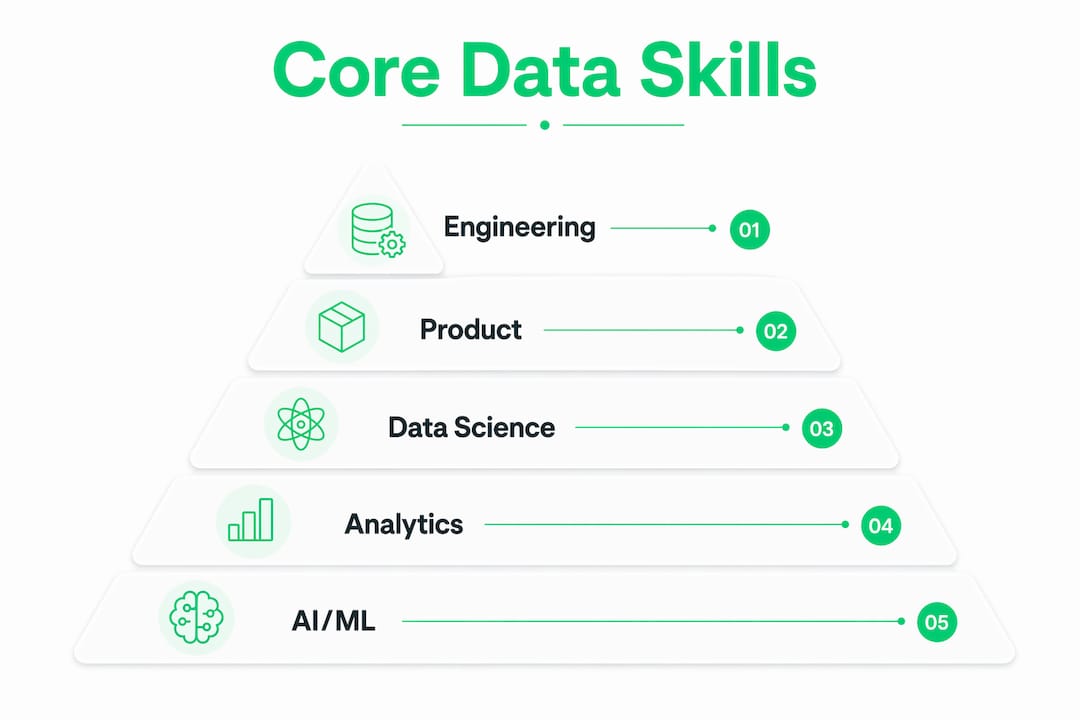
This shift reflects a broader market reality. Data scientists today must master upstream data stack components, and that expectation is spreading to adjacent roles. Companies are hiring for data fluency across the board, not just in dedicated analytics positions.
Pro Tip: If you are a software engineer or PM, learning SQL at a working level takes roughly 20–40 hours of focused practice. That investment pays off immediately in reduced dependency on your data team.
Does data literacy actually improve business outcomes?
The business case for data literacy is measurable. 54% of leaders report faster decision-making and 49% report improved decision accuracy as direct results of data literacy programs. Those are not marginal gains. Faster, more accurate decisions compound over time into real competitive advantages.
The deeper problem is what researchers call the judgment gap. The real workforce problem is not a lack of tools or access to data. Most teams have dashboards, reports, and analytics platforms. The gap is in trained judgment: the ability to critically interpret data and act on it with confidence. Without that judgment, data becomes noise.
“Organizations without a data-literate workforce cannot realize full AI benefits, since employees must validate and act on AI outputs critically.” — Barchart, citing industry expert
This matters especially as AI tools become standard in tech workflows. AI generates outputs constantly. Copilot suggests code. Analytics platforms surface anomalies. Forecasting tools produce projections. None of those outputs are reliable without a human who can question them. Data literacy is now as fundamental as financial literacy or digital skills for any professional working in technology.
The roles that benefit most from closing this gap include:
- Engineers who catch data quality issues before they reach production
- Product managers who make faster feature prioritization calls without waiting for analyst reports
- Marketing technologists who identify underperforming channels without a separate analytics review cycle
- Engineering managers who use incident data to identify systemic problems, not just one-off bugs
How do tech roles use data skills day to day?
Data skills show up in practical, role-specific ways. Here are concrete examples of how different tech professionals apply data literacy in their daily work.
-
Software engineers review data contracts to verify that upstream schema changes will not break downstream services. When a column is renamed or a data type changes, an engineer with data judgment catches the impact before deployment. This is what understanding schema drift looks like in practice.
-
Product managers use dashboards to track feature adoption after a release. A PM who can filter by cohort, adjust date ranges, and cross-reference against a known event does not need to schedule an analyst meeting. They answer their own question in 10 minutes. You can see how this plays out in detail in the product manager roadmap on Projects2jobs.
-
Marketing technologists interpret attribution models to determine which channels drive conversions versus which ones inflate click counts. A marketing technologist who can read multi-touch attribution data makes budget decisions faster and with more confidence.
-
Data engineers and warehouse engineers own the pipelines that every other role depends on. Their data literacy extends to understanding how schema decisions affect analysts, engineers, and product teams simultaneously.
-
Engineering managers use sprint velocity data, incident frequency reports, and deployment metrics to identify team health issues. They do not need to run the analysis themselves. They need to know what questions to ask and whether the answers make sense.
The common thread across all five examples is interpretive judgment. Data literacy as a thinking and communication skill means you do not need to become a data scientist to gain career advantage. You need to read evidence accurately, question assumptions, and communicate findings clearly.
Pro Tip: Build interpretive fluency by documenting your data-based decisions. Write down what you expected, what the data showed, and what you concluded. Reviewing those notes over time sharpens your judgment faster than any course.
Key takeaways
Data literacy is the single most transferable skill in tech, and every role from engineering to product management now requires it to function at a high level.
| Point | Details |
|---|---|
| Data literacy is universal | Reading, interpreting, and acting on data applies to every tech role, not just analysts. |
| The judgment gap is the real problem | Most teams have data access but lack trained judgment to act on it confidently. |
| Business impact is measurable | 54% of leaders report faster decisions and 49% report better accuracy from data literacy. |
| SQL and pipelines are now table stakes | SQL usage in job postings jumped to 79% in 2026, reflecting broader expectations. |
| AI workflows require data validation | Every AI-generated output needs a human who can critically assess whether it is correct. |
Data skills are the career differentiator nobody talks about enough
I have reviewed hundreds of tech career trajectories, and the pattern is consistent. The professionals who advance fastest are not always the best coders or the most technically specialized. They are the ones who can look at a dataset, ask the right question, and communicate a clear conclusion. That skill compounds in ways that certifications do not.
What I find underappreciated is the difference between tool fluency and interpretive judgment. You can learn Tableau or Power BI in a weekend. Knowing whether the trend you are looking at is real, or an artifact of a filter someone forgot to remove, takes deliberate practice over time. That calibration is what separates a good tech professional from a great one.
My advice to students and early-career tech professionals is direct: do not wait until you are in a data role to build data skills. Start now by learning SQL at a working level, practicing on real datasets, and questioning every metric you encounter. The first tech job projects that stand out to recruiters are the ones that show data judgment, not just technical execution.
The professionals who treat data literacy as someone else’s job will find themselves increasingly dependent on others to make decisions. That dependency limits your scope, your speed, and your career ceiling.
— Noah
Build the data skills that get you hired
If you are ready to close your data skill gaps with a structured plan, Projects2jobs is built for exactly that.
Projects2jobs uses AI to analyze your current skills and create a personalized project roadmap aligned with your target tech role. Whether you are aiming for a product manager, data engineer, or engineering manager position, the platform identifies the specific data and technical skills you are missing and guides you through projects that prove those skills to recruiters. You build a portfolio that shows judgment and execution, not just familiarity with tools. Start with the AI Project Roadmap Builder and get a clear path from where you are to where you want to be.
FAQ
What are data skills in a tech career context?
Data skills in tech careers refer to the ability to read, interpret, analyze, and communicate with data effectively. This includes dashboard interpretation, SQL querying, and applying data insights to decisions, not just statistical modeling or coding.
Do software engineers need data skills?
Software engineers benefit directly from data skills by understanding data contracts, schema drift, and pipeline behavior. These skills protect product quality and reduce dependency on dedicated data teams for routine decisions.
How do data skills relate to AI in the workplace?
AI tools generate outputs that require human validation. Data literacy is now fundamental for employees to critically assess AI-generated insights and act on them accurately, making it a core skill in any AI-integrated workflow.
What is the judgment gap in data skills?
The judgment gap describes the disconnect between having access to data and having the trained ability to interpret and act on it confidently. Most organizations have data tools but lack professionals who can use them with critical rigor.
How quickly can you build practical data literacy?
Working-level SQL takes roughly 20–40 hours of focused practice. Interpretive judgment develops over time through deliberate reflection on data-based decisions, reviewing what you expected versus what the data showed.